-
 +86-0571-83175630
-
 [email protected]

 English
  Español
  عربى
عربى 
Clear Vinyl Protective Film: Uses, Types, and Selection Guide
Content
What Clear Vinyl Protective Film Is and How It Works
Clear vinyl protective film is a thin, transparent polymer sheet with a pressure-sensitive adhesive backing, applied to surfaces to shield them from scratches, scuffs, abrasion, UV exposure, and contamination. The film acts as a sacrificial layer — taking damage that would otherwise reach the substrate beneath — and can be removed cleanly when protection is no longer needed or when the film itself has reached the end of its service life.
The base material is polyvinyl chloride (PVC), chosen for its flexibility, optical clarity, and dimensional stability across a wide temperature range. The film is manufactured by calendering or casting PVC compound into uniform sheets, then coating one side with an acrylic or rubber-based pressure-sensitive adhesive. Liner paper or polyester film covers the adhesive until the product is applied.
Thickness is the primary structural variable, typically ranging from 50 to 250 microns depending on the application. Thinner films (50–75 microns) are used where conformability and minimal visual profile matter most, such as painted automotive panels or curved display screens. Thicker films (150–250 microns) are selected for industrial surface protection during fabrication, transit, or construction, where the film must resist puncture and abrasion from handling equipment and contact surfaces.
Common Surface Applications
Clear vinyl protective film is used across a wide range of industries and substrates, and the demands placed on the film vary considerably between them.
Automotive and Transportation
Paint protection film (PPF) applied to vehicle hoods, bumpers, door edges, and mirror housings is one of the highest-profile uses of clear vinyl protective film. Automotive-grade films are typically cast rather than calendered, giving them superior conformability on complex curves and resistance to yellowing from UV exposure. Self-healing topcoats — which use elastomeric polymers that flow back into minor scratches under heat — are now standard on premium automotive grades.
Electronics and Display Screens
Protective film is applied to smartphone screens, laptop lids, touchscreen panels, and control interfaces during manufacturing and retained by end users for ongoing scratch protection. These films require optical-grade clarity with haze values below 1% and surface hardness coatings to resist stylus and fingernail abrasion without reducing touch sensitivity.
Architectural Surfaces and Building Materials
Aluminum composite panels, stainless steel cladding, polished stone slabs, and anodized aluminum extrusions are routinely shipped and installed with a factory-applied clear vinyl protective film. The film prevents surface damage during cutting, fabrication, transit, and installation, and is stripped off at project completion. These films prioritize clean removability — leaving no adhesive residue even after months of outdoor exposure — over optical performance.
Industrial Fabrication and Manufacturing
Sheet metal, plastic panels, coated glass, and precision-machined components are protected during CNC routing, stamping, bending, and assembly operations. Industrial protective films must withstand coolant exposure, metal swarf contact, and the mechanical stresses of forming operations without delaminating or tearing prematurely.
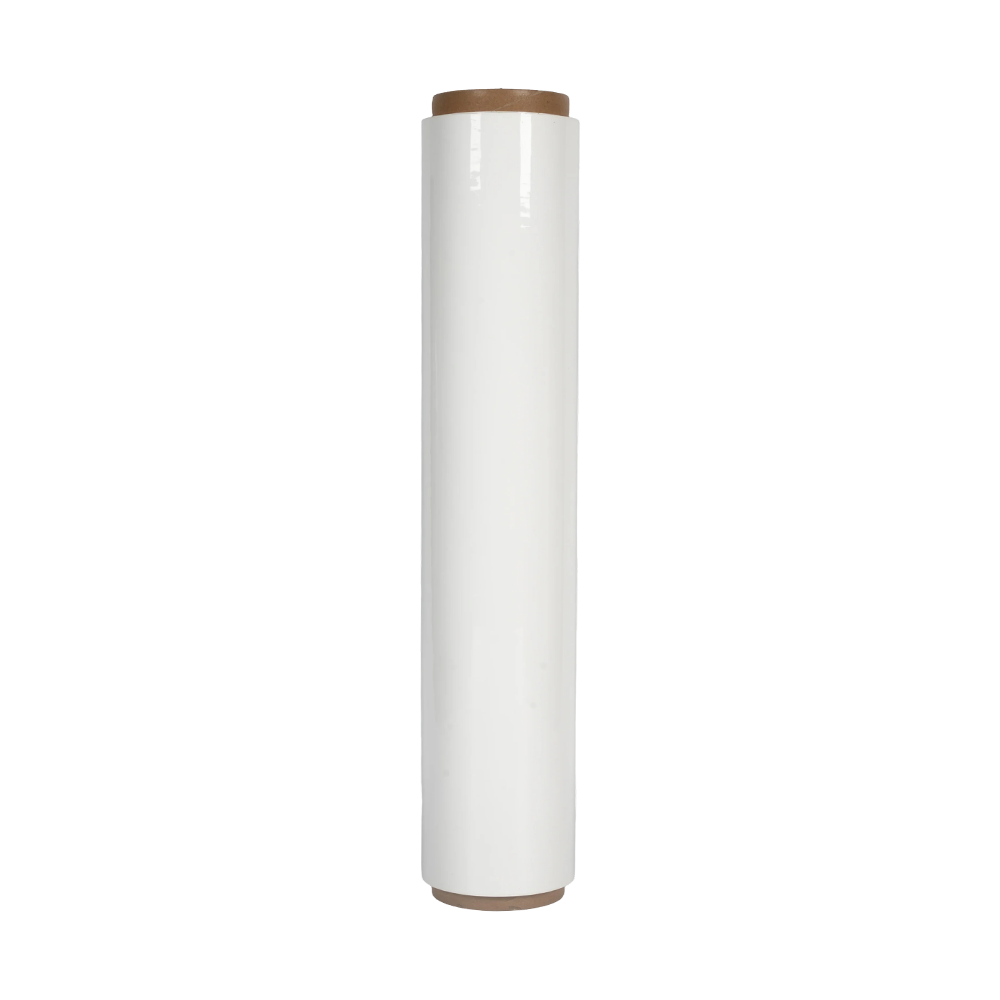
Film Types and Construction Differences
Not all clear vinyl protective films are interchangeable. Manufacturing method, adhesive chemistry, and additive package determine which film is appropriate for a given surface and service environment.
| Film Type | Manufacturing Method | Key Characteristics | Best Suited For |
|---|---|---|---|
| Calendered vinyl film | Rollers compress heated PVC into sheet form | Lower cost, moderate conformability, may have residual memory stress | Flat or mildly curved surfaces, short- to medium-term protection |
| Cast vinyl film | Liquid PVC cast onto a release liner and cured | Higher dimensional stability, excellent conformability, no memory stress | Complex curves, long-term outdoor exposure, automotive PPF |
| Optical-grade film | Cast with optically pure formulation and hard coat | Ultra-low haze, anti-fingerprint or anti-glare surface options | Screens, displays, touchpanels |
| Industrial masking film | Calendered, often thicker gauge | High puncture resistance, easy hand-tear, low-tack removable adhesive | Fabrication, transit protection, construction site masking |
Adhesive Systems: Choosing the Right Tack Level
The adhesive is often the most critical selection variable, because a film that bonds too aggressively to a sensitive surface can cause more damage on removal than the protection was worth. Three adhesive categories cover the majority of applications:
- Low-tack removable adhesive: Designed for smooth, non-porous surfaces where residue-free removal is the priority. Used on painted metals, polished stone, coated glass, and anodized aluminum. Tack is typically 100–300 g/25mm peel strength. Not suitable for textured or porous surfaces, where the adhesive may not make adequate contact to hold the film securely.
- Medium-tack acrylic adhesive: The most broadly applicable category. Bonds reliably to a wide range of substrates including powder-coated surfaces, plastics, and brushed metals. Removable within the recommended service period (typically 6–24 months) without residue on most surfaces.
- High-tack or permanent adhesive: Used where the film must remain in place under mechanical stress, outdoor weathering, or chemical exposure. Removal becomes progressively more difficult over time and may require solvents. Reserved for applications where long-term bonding is more important than clean removability.
For freshly painted or recently coated surfaces, allow full cure before applying any protective film — even low-tack adhesives can bond to incompletely cured coatings and cause surface damage on removal. Most automotive coatings require a minimum of 30–90 days of cure time before PPF application, depending on the paint system.
Performance Factors to Verify Before Specifying
Beyond thickness and adhesive type, several additional performance properties determine whether a clear vinyl protective film will perform reliably over its intended service life.
- UV resistance: Unprotected PVC yellows and embrittles under prolonged UV exposure. Films intended for outdoor or window-adjacent use should contain UV stabilizers and have documented weathering data — typically expressed as hours of QUV accelerated weathering without significant yellowing (ΔE < 2.0).
- Temperature range: Verify the film's rated operating temperature against the application environment. Films applied to surfaces that reach 60°C or above in direct sunlight (metal panels, vehicle hoods) require adhesive systems formulated for elevated temperature service.
- Chemical resistance: Industrial and automotive applications expose films to lubricants, cleaning agents, fuel, and solvents. Request the supplier's chemical resistance chart and verify compatibility with the specific chemicals present in your application environment.
- Elongation at break: A measure of how far the film can stretch before tearing. Higher elongation (typically 150–300% for cast films) is essential for applications involving complex curves, post-application forming, or surfaces subject to flexing and vibration.
- Shelf life and storage conditions: Pressure-sensitive adhesive films have a finite shelf life, typically 12–24 months from manufacture when stored at 21°C and 50% relative humidity. Adhesive properties degrade with heat and humidity exposure, so verify manufacturing date and storage conditions at time of purchase.
Requesting a technical data sheet (TDS) and safety data sheet (SDS) from the supplier before purchasing in volume is standard practice. Performance claims on product listings are not a substitute for documented test data, particularly for applications where film failure would result in costly surface damage or project rework.
LATEST POST
Let’s create something amazing together
contact us
CONTACT DETAILS
- Address:No. 241, Yaojiafan, Zhangpanqiao, Shushan Street, Xiaoshan District, Hangzhou City, Zhejiang Province, China
- TEL:+86-0571-83175630
- Phone:+86-13336160217
- Email:[email protected]
- WeChat/WhatsApp:+86-18058115265
PRODUCTS
NEWS CENTER
MOBILE TERMINAL
Copyright© Zhejiang Geruite Packaging Materials Co., Ltd. All Rights Reserved.
Privacy Wholesale industrial packaging tape Manufacturers